Shots, Pulses, and kJ in Lifting Devices: Are They Comparable Units? Understanding Standards and Differences
Numbers in lifting consultations are not the same type of unit. Ultrasound manuals count "lines," with multiple thermal coagulation points per line, and energy set in Joules (J) per point. Radiofrequency (RF) treats an area at once and shows energy density (J/cm²). kJ is the total energy delivered, not a count. Since they measure lines vs. areas vs. totals, direct comparison is impossible.
이 글은 일반적인 상담 준비 정보입니다. 개인별 피부 상태와 시술 계획은 의료진 상담에서 확인해야 합니다.
Numbers come first in lifting consultations.
300 shots, 600 shots, 100 pulses, 80 kJ. Because they are listed together on price lists, they appear on the same line, and appearing on the same line makes them seem comparable.
These numbers are often the first thing patients bring up after comparing several clinics in Gangnam. However, when you open the manufacturer's instruction manual, these numbers are actually counting different things.
What do Shots, Pulses, and kJ each measure?
Lines, areas, and totals.
One counts the lines a device passes over once, one counts the number of times the area touched by a tip is processed, and one records the total amount of energy delivered. If the shape of the object being counted is different, the numbers cannot be converted between each other.
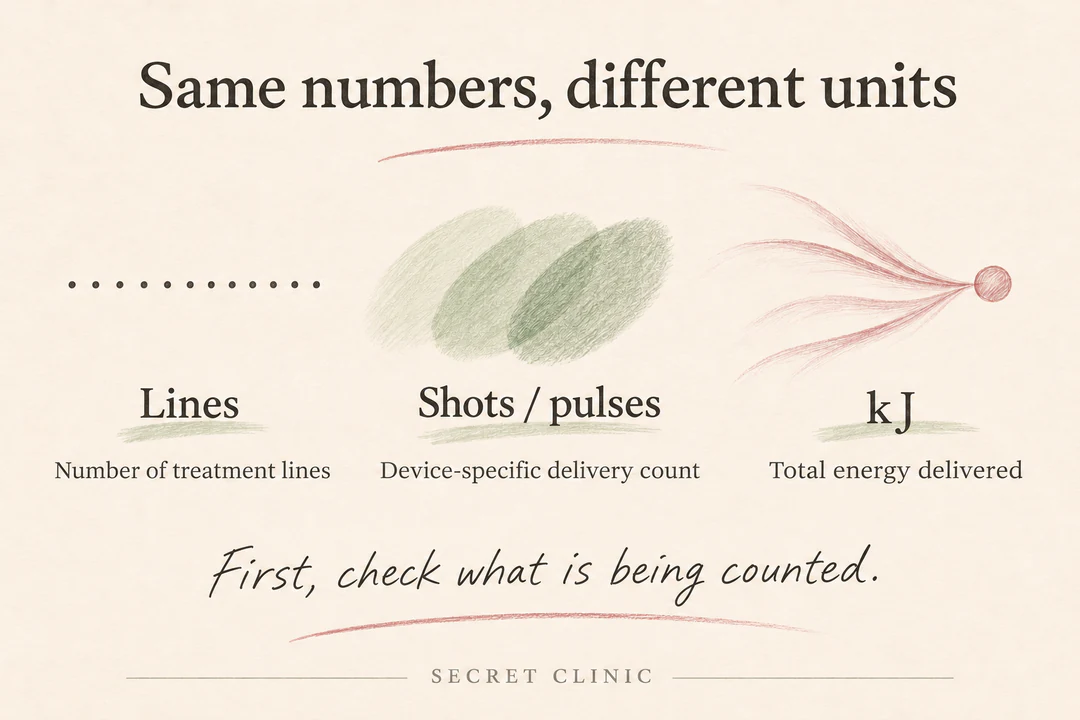
The unit for Ultrasound Lifting is "Lines"
The word "shot" does not appear in manufacturer documents.
The manufacturer's manual for Ultherapy Prime™ refers to a single delivery as a "treatment line," or "line" for short. What appears on the device screen is also the number of lines. And one line is not a single point. Thermal coagulation points smaller than 1mm³ are created wherever the ultrasound focuses, and those points line up to form a single line.
The number of points is not fixed. The line length is set between 5–25mm, and the spacing between points is set between 1–5mm, with a standard value of 1.5mm. If the length is 25mm and the spacing is 1.5mm, 17 points are created in one line. If you increase the spacing, fewer points will fit in the same line.
Energy is also set in Joules (J) per point, not per line. Looking at the table in the manufacturer's document, it varies from 0.15 J to 1.20 J depending on the transducer and level. The highest level for a transducer targeting a depth of 4.5mm is 1.20 J, while the lowest level for one targeting 1.5mm is 0.15 J. That is an eightfold difference.
In summary, "300 lines" tells you neither how many points were created nor how much energy was delivered. Those two factors are in the settings, and settings exist outside of that number.
The unit for Radiofrequency (RF) Lifting includes area
It processes the area touched by the tip all at once.
Monopolar RF devices place the entire tip surface against the skin and heat the area beneath it simultaneously. The technical manual released by the manufacturer counts this single action as an "RF energy pulse," and the remaining count decreases one by one on the screen.
The important thing here is that the contact area varies by tip. The same manufacturer's manual lists 0.25cm², 3.0cm², and 16.0cm² tips together. The area of a tip for narrow areas like the eyes and a tip for the body differs by more than sixty times. The range covered by the same "one pulse" is that different.
Energy notation is also different. While settings are made in levels from 0.5 to 9.5, the value actually displayed is the **energy density per area (J/cm²)**. This means the area is already included in the unit. This is why Secret Clinic does not place numbers side-by-side when explaining RF and ultrasound systems together.
kJ is a quantity, not a count
It is the total amount of energy delivered.
kJ stands for kilojoules, a unit for measuring the amount of energy. It records how much total energy went in, not how many times it was fired. Therefore, in procedures labeled in kJ, the count does not appear on the menu.
While the total amount is clear information, it does not tell you about the distribution. Even with the same 80 kJ, a procedure where it is spread widely is different from one where it is concentrated narrowly.
Can we compare kJ between different devices?
Even with the same unit, comparison is difficult if the mechanism is different.
RF devices also show total energy in kJ. This makes one want to match the kJ of a microwave device with those numbers, but the two methods differ in how energy is absorbed by tissue and the depth at which heat accumulates. Having the same physical unit means they are "measuring the same physical quantity," not that they "produce the same result."
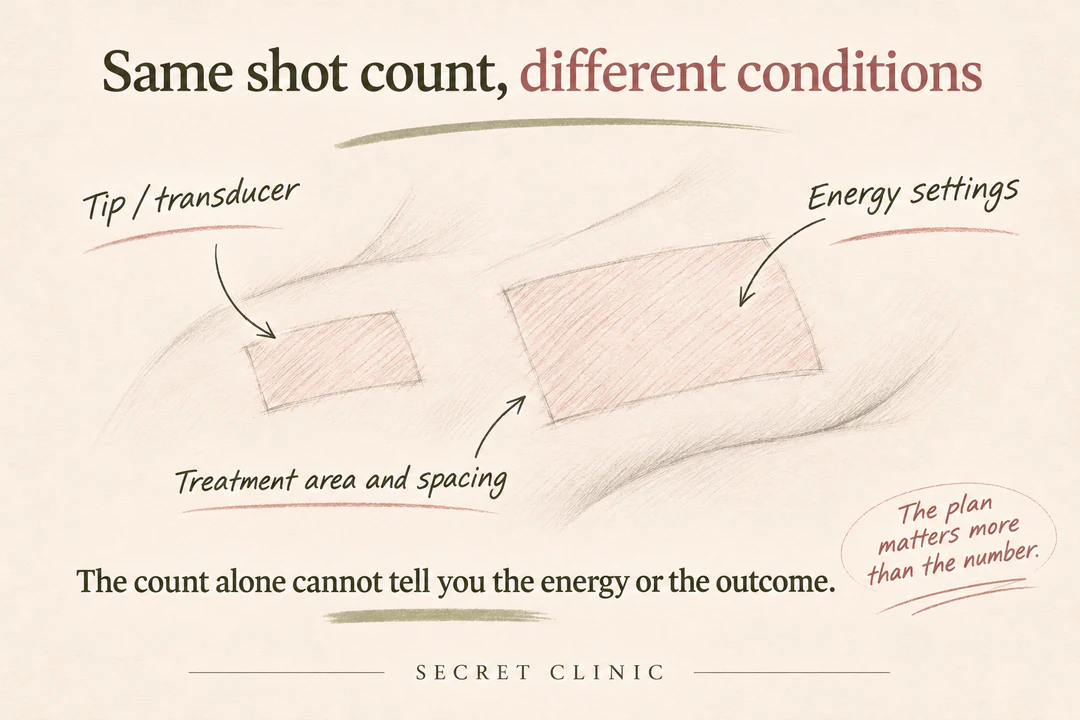
Even within the same device, changing the transducer or tip makes the same number represent a different amount. For a comparison to be valid, the device, tip, depth, and area must all be identical—a condition that, in reality, is only met by your own previous treatment records.
So, are the numbers meaningless?
They become meaningful when viewed alongside the area.
A clue lies in how the recommended number of lines is presented in manufacturer documents. There is a section where the number of lines is not written as "how many per area," but as how many per 2.5×2.5cm square. This means the standard is density per area, not the total count. It is also noted that the number of squares "may vary depending on the patient's anatomy."
Therefore, even with the same count, it differs depending on how much area was covered. Furthermore, concentrating it in a narrow range is not always advantageous. The manufacturer's manual instructs to move 2–3mm before delivering the next line and warns that if sufficient spacing is not maintained, tissue may overheat, leading to adverse reactions. There is also a specific item warning not to deliver lines continuously without moving the position.
What is decided before the numbers
The order is: Area, Depth, and then Settings.
Once you decide where to cover, the necessary count follows. Once you decide which depth to target, the transducer or tip is determined. The level is set while observing tissue thickness and heat sensation during the procedure. The number is a value that comes as a result of this process, not the starting point.
Manufacturer documents do not reverse this order. There is no description in the documents linking the number of lines directly to results; clinical efficacy was confirmed at pre-determined energy levels, and it is written that "changing the energy may affect efficacy." In other words, the value that must be managed and not changed is the setting, not the count.

Conclusion
Numbers are not a ruler for measuring the scale of a procedure, but traces of a treatment plan. Rather than comparing them with numbers from other devices, it is more helpful for future decisions to record what settings were used and what area was covered for the same device and same area last time. The reason Secret Clinic keeps treatment records is to set the standard for comparison to yourself, not to the outside world.
자주 묻는 질문
Is it better to have a higher number of shots?
Increasing the number expands the coverage area, but concentrating them in the same area increases the density. The manufacturer's manual instructs to maintain sufficient line spacing and warns that insufficient spacing can lead to overheating. Rather than 'more is better,' the number is determined by the area to be covered.
Is 600 shots twice as effective as 300 shots?
The count is double, but that doesn't mean the result is double. Increasing the count is usually intended to cover a wider area; it is not designed to simply apply double the energy to the same area. It is better to check which areas are included in the treatment plan.
Can I compare my shot count with one I received elsewhere?
It can be a reference if the device, transducer, and area are all the same. If even one condition differs, the same number represents a different amount of energy. Rather than a direct comparison, it is more helpful to bring a record of which areas you received treatment on at that time.
Are pulses and shots the same thing?
It depends on the device. In RF systems, it refers to the number of times the tip area is processed. In ultrasound systems, what manufacturer documents call 'lines' are often referred to as 'shots' or 'pulses' during consultations. It is more accurate to check whether that 'one time' refers to a line or an area rather than focusing on the name.
If there is less pain, does it mean the energy was low?
Heat sensation is used as a reference signal for adjusting settings. The manufacturer's manual for RF devices states that the heat and discomfort felt by the patient during the procedure are necessary inputs for determining a safe and effective level. However, since the degree of sensation varies by area and individual, it is difficult to directly correlate the level of pain with the level of energy.
Is there a difference between receiving shots divided into multiple sessions versus all at once?
The reason for dividing sessions is often to monitor recovery and response rather than simply splitting the count. How the total count is divided depends on the area and skin condition, so it cannot be said that dividing sessions is always advantageous.
Can I check the numbers on the device screen?
Some devices display the remaining count on the screen, so you can view it before and after the procedure. However, since the screen shows the count and the settings are separate, checking the count alone does not provide the full details of the procedure.
원리, 상담 대상과 주의사항을 시술 상세페이지에서 함께 확인해 보세요.
시술 상세 보기온라인 상담 신청
현재 고민과 연락 가능한 정보를 남겨주시면 확인 후 상담을 도와드립니다.