What Distinguishes Sofwave 100, 200, and 300 Pulses?
The first question in a Sofwave consultation is often how many pulses to receive. However, this number counts how many times the device was pressed, not the intensity of the treatment. Comparing numbers without considering where and how much was used is meaningless. This article explains what the pulse count represents, whether there are official recommended standards, and cases where increasing the number is not the answer.
이 글은 일반적인 상담 준비 정보입니다. 개인별 피부 상태와 시술 계획은 의료진 상담에서 확인해야 합니다.
When you receive a Sofwave consultation, you are usually asked this question first.
“How many pulses would you like?”
When numbers like 100, 200, and 300 are placed side by side, it naturally seems like the higher number is stronger. However, this number does not indicate intensity. You must first understand what the number is counting to make a proper comparison.
Pulse is frequency, not intensity
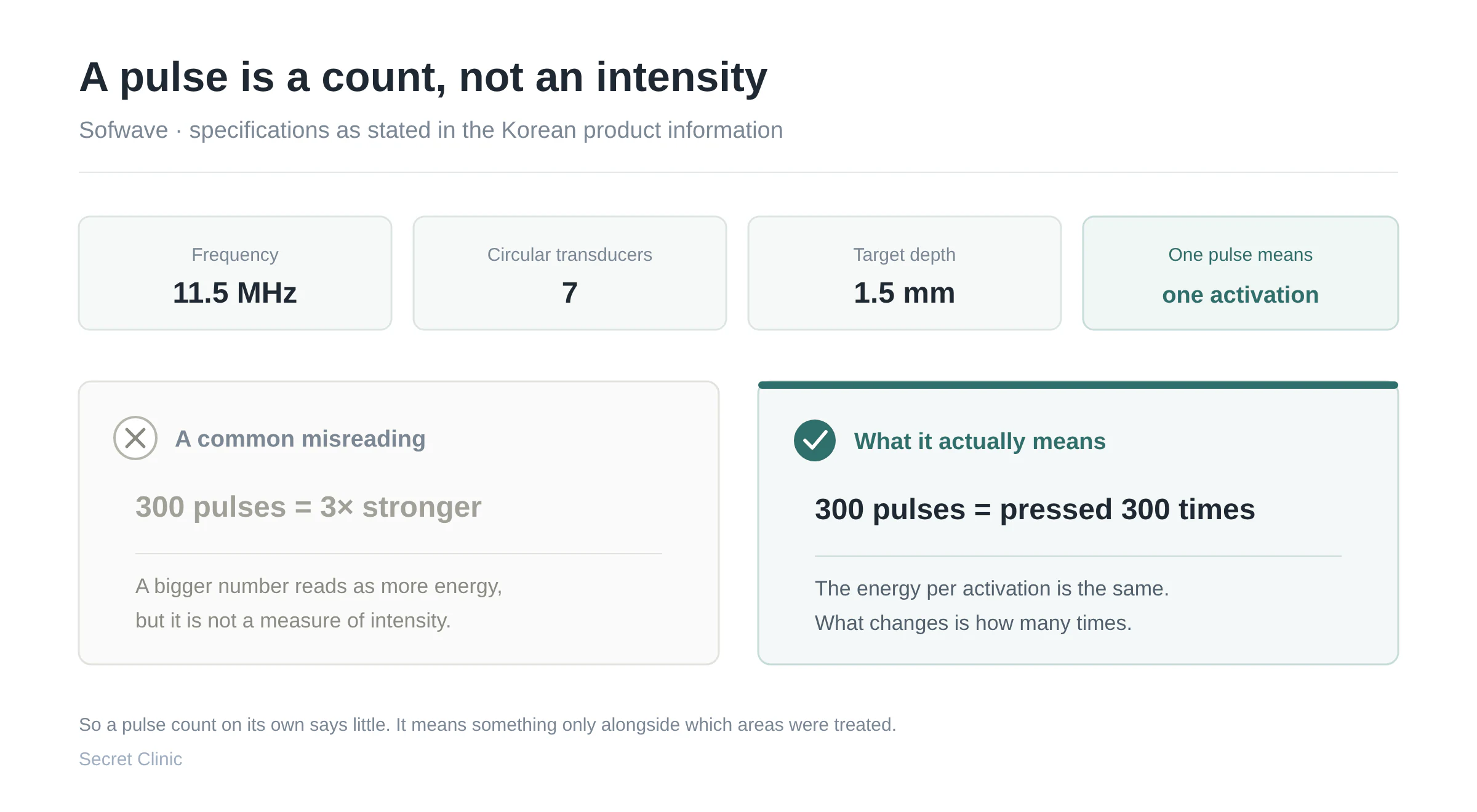
Sofwave is a device that uses ultrasound. According to official domestic data, it uses 11.5MHz ultrasound, contains 7 circular transducers, and is designed to act on a point 1.5mm deep in the skin.
Here, one pulse means placing this transducer on the skin and operating it once. In that one operation, energy is delivered to a set area.
Therefore, 100 pulses means it was pressed 100 times, and 300 pulses means it was pressed 300 times. The energy delivered in a single press does not triple. This is usually where misunderstandings arise when simply comparing numbers during Sofwave consultations in Gangnam.
Thus, the number comes from the area covered
The process of determining the Sofwave pulse count is simple. Since the area covered by one pulse is fixed, the number of times needed to cover a certain range without gaps follows naturally.
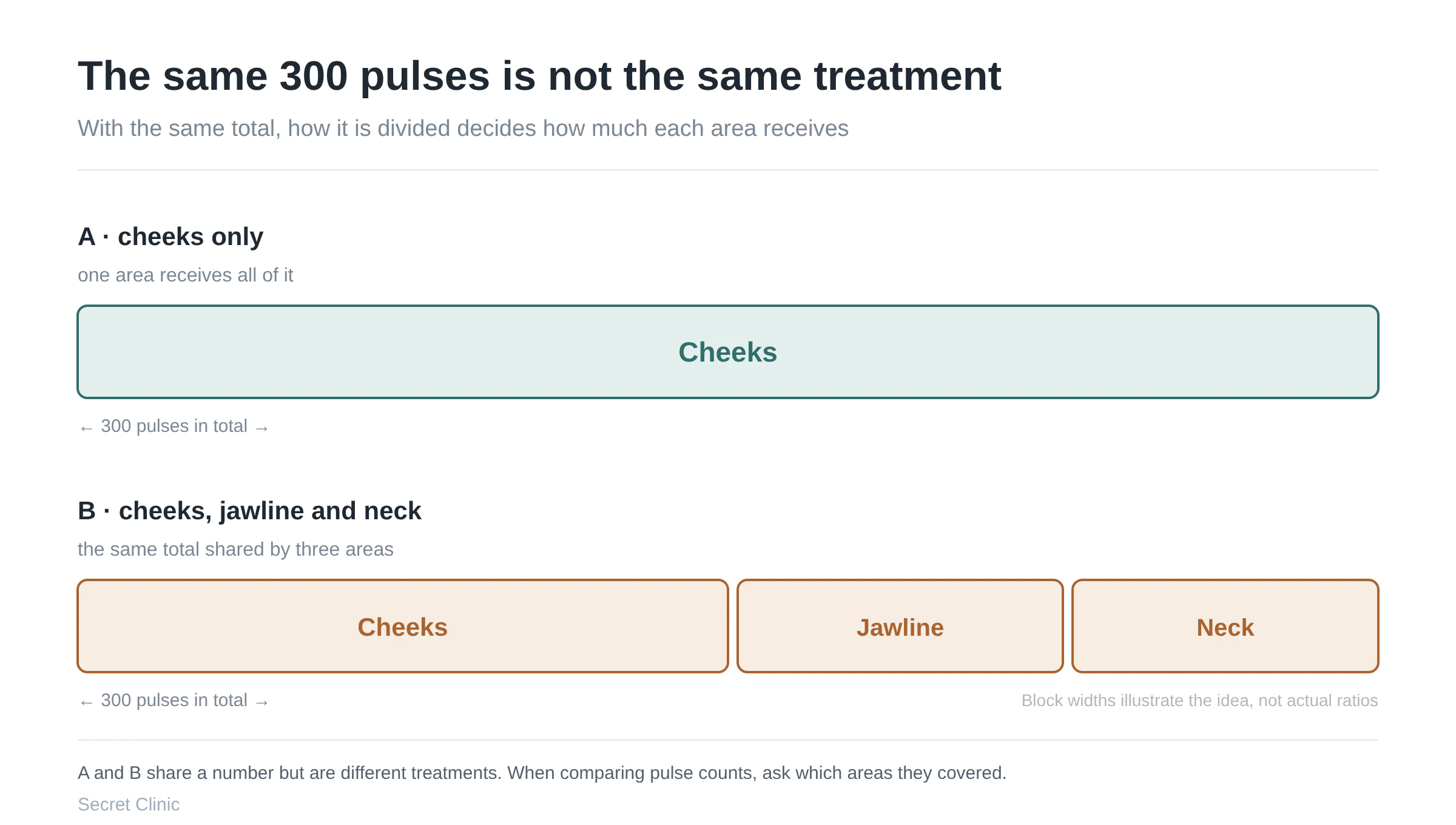
If you only treat both cheeks, you need a certain amount; if you go down to the jawline, more are needed; if you include the neck, that much more is added. The number is the result of this accumulation. An intensity of 100 or 300 does not exist from the start.
Once you know this, an important fact becomes visible. Even with the same 300 pulses, the procedure becomes completely different depending on where they were used. Using 300 pulses densely only on the cheeks is different from dividing 300 pulses among the cheeks, jawline, and neck in terms of the amount each area receives.
Therefore, simply comparing the pulse count you received elsewhere is not very meaningful.
To compare, you must know how many pulses were used on which area.
There are no standards in official data on how many pulses to use
It is better to be clear about this part.
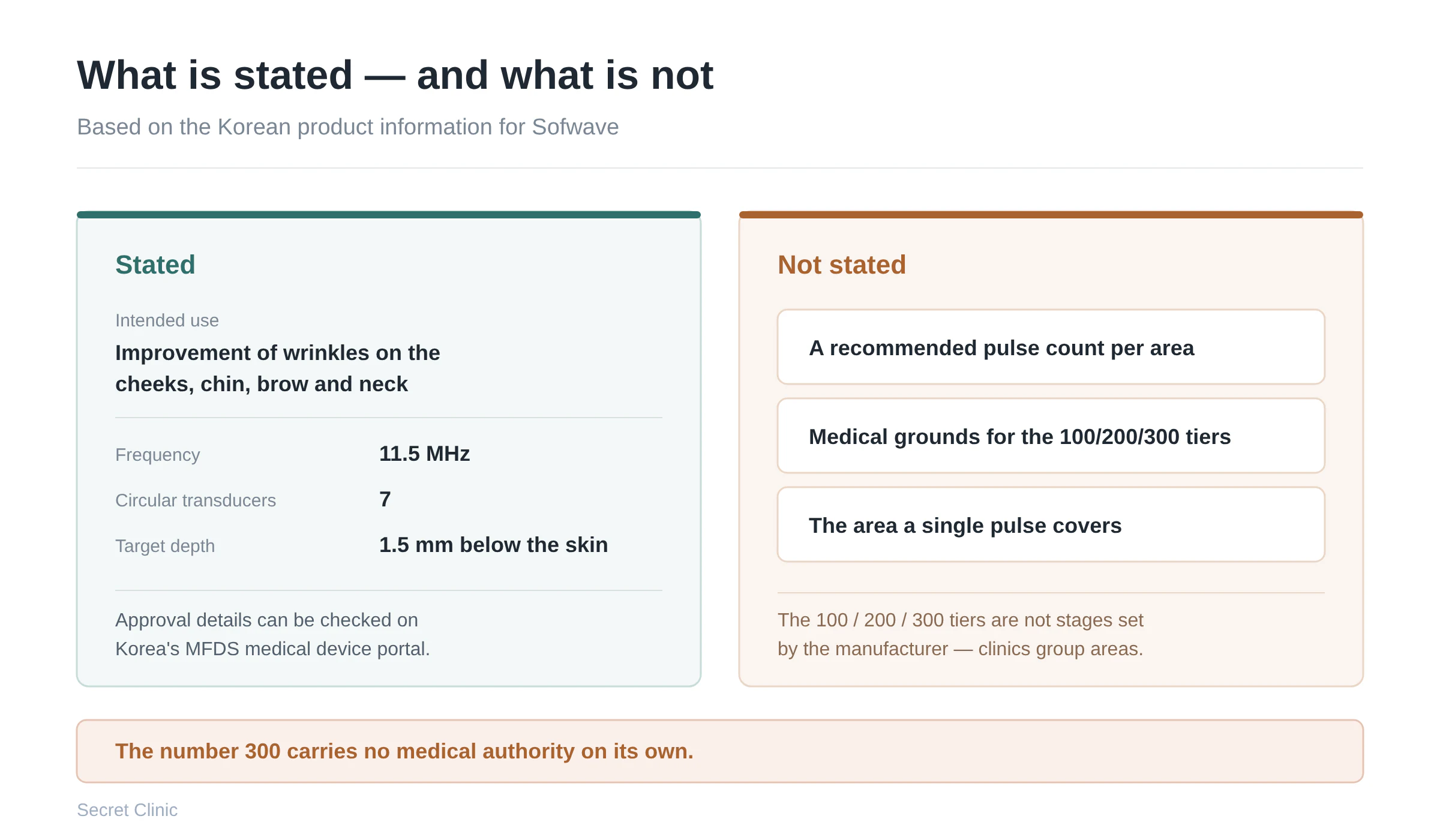
Official domestic data lists the purpose of use and technical specifications of the device, but recommended pulse counts for each area are not specified. The intervals of 100, 200, and 300 are not treatment stages set by the manufacturer, but rather configurations created by clinics to group and guide treatment ranges.
This doesn't mean it's wrong. Setting the range in advance makes guidance easier. However, if you accept these numbers as medical stages, your judgment will be flawed. There is no medical authority in the number 300.
So, what you should ask during a consultation is not "How many pulses are good?" but "How much of my face do you plan to treat?" Once the range is determined, the pulse count follows from there.
Cases where increasing the number is not the answer
Widening the range is different from applying more shots to the same spot. In the following cases, increasing the number may not be the answer:
· When volume loss in the cheeks is the main change rather than sagging — Widening the coverage won't fill the hollow areas.
· When the skin is thin and sensitive to irritation — Overlapping shots on the same spot can prolong redness.
· When there was significant discomfort in previous procedures — It is better to adjust the settings before the quantity.
· When the goal is clearly one area, like under the chin — It is better to treat that area properly rather than widening the range.
The same applies to increasing the frequency of lifting sessions. It takes time for tissue to react and settle, and that time does not shorten by performing more procedures.
At Secret Clinic, we do not choose the product package first when determining the pulse count. We decide which area to treat first, then determine the number needed to cover that range.
You must first look at the authorized range
According to official domestic data, the purpose of use for this device is stated as "an instrument used to improve wrinkles on both cheeks, chin, eyebrows, and neck." Authorization is not given vaguely for the "face" but lists specific areas like this.
The fact that authorized areas are defined this way is significant in consultations. It is good to check if the explanation you receive falls within this range.
You can directly check the current authorized details by searching for the product name in the Product Information section of the Ministry of Food and Drug Safety's Medical Device Electronic Service.
Good things to ask during a consultation
If you are comparing several dermatology clinics on Gangnam-daero, it is more practical to ask the following rather than the pulse count:
· Which areas do you plan to treat?
· How many pulses will be used for each of those areas?
· Why that specific range? — What changes do you see in my face now?
· Which areas do not need treatment right now?
At Secret Clinic, consultations proceed in this order. A consultation where the last question is answered is generally trustworthy. This is because it is harder to explain what to take away than what to add.
Limitations and risks you should know
As this is a procedure using heat, pain may occur during the treatment. It is often felt more sensitively in areas close to the bone or where the skin is thin.
Temporary redness or swelling may appear after the procedure and usually subsides without special treatment. In rare cases, skin damage or blisters due to heat may occur, so please inform us immediately if you feel anything unusual during the procedure.
The changes obtained are not permanent. Aging continues even after the procedure, so it is best not to think of it as a one-time treatment.
Furthermore, if you are pregnant, have inflammation or wounds in the treatment area, or have recently received other procedures in the same area, you must consult first before proceeding. Secret Clinic also checks these items first during the medical interview.
In Summary
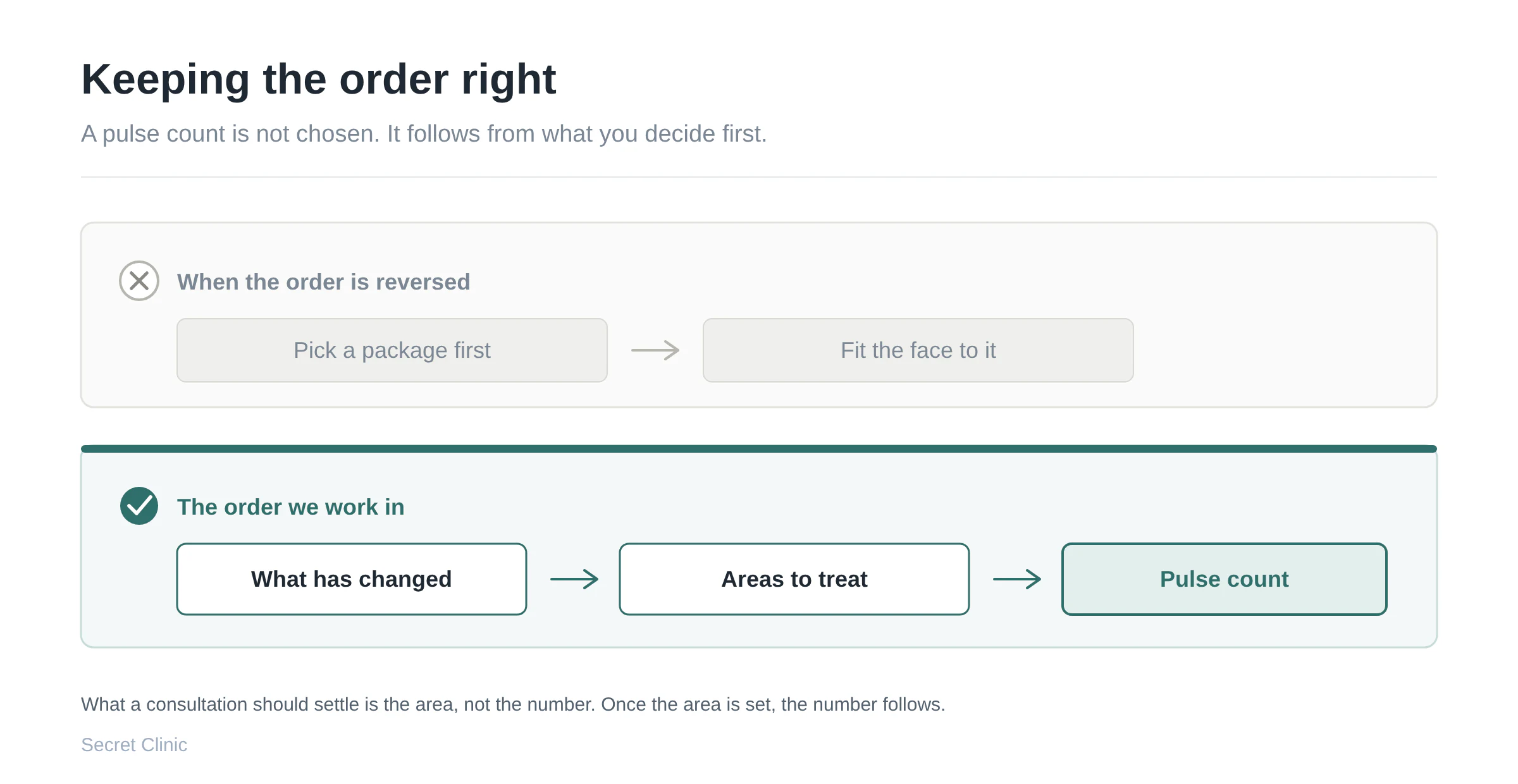
Sofwave pulse count is a frequency, not intensity, and that frequency comes from the area to be covered. Therefore, comparing the number alone is meaningless.
It is also good to remember that recommended pulse counts for each area are not set in official data. Intervals like 100, 200, and 300 are configurations for guidance, not medical stages.
What needs to be decided in a consultation is the range, not the number. Once the range is set, the number follows.
자주 묻는 질문
Is the effect better with more pulses?
It is difficult to see it that way. The pulse count is a number derived from the area covered; it increases if the range is widened and decreases if it is narrowed. Applying more shots to the same range is different from widening the range, and that is not always the better choice.
I received 300 pulses elsewhere, but here it says 200 pulses. Is this a loss?
You must look at which areas were treated to make a comparison. The amount each area receives varies depending on whether it was used only on the face or included the neck. It is difficult to say which one received more based on the number alone.
Is 100 pulses insufficient?
If the area is set narrowly, 100 pulses may be used to cover that range. Whether it is insufficient or not is judged by whether the target range was covered, not by the number. It is good to first check which areas are planned to be treated.
Is there an officially recommended pulse count?
We could not find recommended pulse counts for each area in official domestic data. It is more accurate to view intervals like 100, 200, and 300 as configurations created by clinics to group and guide treatment ranges.
Which areas can be treated?
According to official domestic data, the purpose of use is for the improvement of wrinkles on both cheeks, chin, eyebrows, and neck. You may check if the explanation during the consultation falls within this range.
How much pain is there?
You may feel a hot or stinging sensation, and it is often felt more sensitively in areas close to the bone or where the skin is thin. Individual differences are significant. If you are sensitive to pain, please let us know when booking so we can discuss the intensity and anesthesia method together.
Is daily life possible immediately after the procedure?
Temporary redness or swelling may occur, but it usually subsides. It is best not to rub the treated area hard on the day of the procedure, and for a few days, avoid environments where heat is applied for a long time, such as saunas, and excessive drinking.
How many times should I receive it?
Rather than setting the number of sessions in advance, it is reasonable to receive it once, observe the progress, and then decide on the next step. It takes time for tissue to react and settle, and that time does not shorten by performing more procedures.
Can I receive it along with other ultrasound lifting?
If the procedures target different layers, they are sometimes planned together. However, whether to proceed on the same day or leave an interval depends on the area and intensity, and since evidence for the interval of combined use has not been established, it is not uniformly recommended. If you have recently received any procedures, please inform us of the timing and area.
원리, 상담 대상과 주의사항을 시술 상세페이지에서 함께 확인해 보세요.
시술 상세 보기온라인 상담 신청
현재 고민과 연락 가능한 정보를 남겨주시면 확인 후 상담을 도와드립니다.