Thermage, Ultherapy Prime, and Sofwave: What's the Difference?
Energy-based lifting treatments all share the principle of "delivering heat to induce a tissue recovery response." The difference lies in which layer and in what pattern that heat is delivered. RF heats a wide volume, while focused ultrasound creates heat at specific points. Even with ultrasound, different target depths result in different treatments. Planning two or more together can be helpful, but since evidence for the order and interval of combinations is still limited, it should be distinguished from a "more is better" approach.
이 글은 일반적인 상담 준비 정보입니다. 개인별 피부 상태와 시술 계획은 의료진 상담에서 확인해야 합니다.
The most frequent question in anti-aging consultations is "Which is better, Thermage or Ultherapy?" It is a difficult question to answer, not because it is hard to determine which is superior, but because the two are not on the same axis. Ranking treatments that work on different layers is similar to asking whether a screwdriver or a hammer is a better tool.
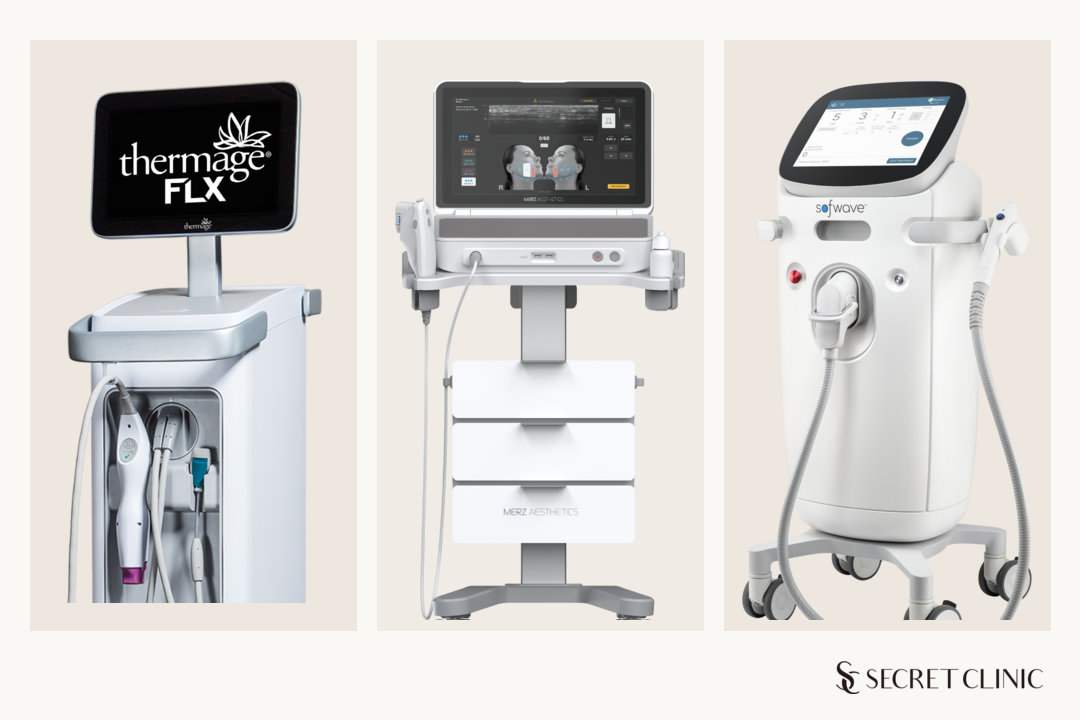
Therefore, in consultations, we do not start by deciding on the device name; instead, we first identify what has actually changed in the face. Once we determine which layer those changes originated from, the options naturally narrow down.

What the Three Treatments Have in Common
First, it is important to note that if sagging has progressed significantly and there is a large amount of excess skin, a surgical approach via incision is the standard procedure. The treatments discussed below are considered before reaching that stage or when surgery is not a preferred option. Many materials explain this order differently, which does not help in setting realistic expectations.
Based on that premise, treatments using radiofrequency (RF) and ultrasound fall into the same category of principles. Without making incisions, they deliver heat to specific layers within the skin, inducing the body to produce and rearrange new collagen during the recovery process triggered by that heat.
Two things follow from this. One is time. Since recovery and remodeling take weeks to months, it is difficult to judge results based solely on the impression immediately after the procedure. The other is individual variation. Even when receiving the same energy, tissue response varies from person to person.
RF and Ultrasound Apply Heat Differently
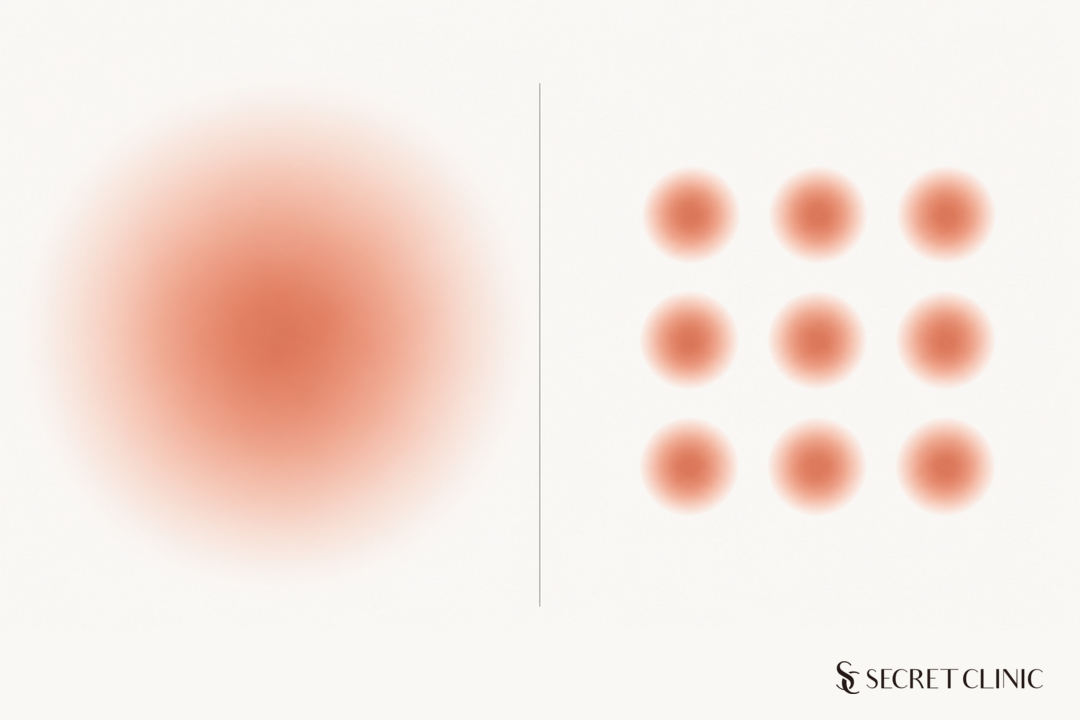
Monopolar radiofrequency (RF) uses heat generated by the rotation of molecules as current passes through the tissue. This method is characterized by heating a relatively large volume all at once. It is reported that an immediate contraction of collagen due to heat occurs alongside the subsequent production of new collagen and elastic fibers during the wound-healing process.
Cooling is used simultaneously to protect the epidermis. However, cooling is not just a free safety feature. Literature points out that while cooling reduces the risk of burns, it exists in a trade-off relationship with penetration depth. This means that safely delivering energy deep into the skin is technically complex.
Focused ultrasound works differently. It concentrates ultrasound energy into a single point, momentarily raising the temperature at that specific spot. Similar to focusing sunlight with a magnifying glass, microscopic thermal coagulation points are created at the focal point, rather than along the path the energy travels. It is a method of creating points rather than heating a broad area.
These two methods do not replace each other. Heating a broad volume and creating points involve different types of stimulation to the tissue.
Even with Ultrasound, the Target Layers Differ
This is where the most frequent misunderstandings occur. Treatments grouped under the single term "ultrasound lifting" actually target different depths.
Ultherapy Prime™ (ULTHERAPY PRIME®) is designed to focus at different depths of 1.5 mm, 3.0 mm, and 4.5 mm. A structural feature of this device is the ability to approach layers from the dermis to the underlying support structures while visualizing the layers with real-time ultrasound imaging.
Sofwave™ (SOFWAVE™) uses 11.5 MHz ultrasound and is designed to place its action point at the 1.5 mm mid-dermis. Although it belongs to the ultrasound category, it targets the dermis rather than the deep support layers, meaning it approaches a different layer.
Therefore, saying "I had ultrasound and it didn't work" is not enough information for assessment. We must look at which depth was targeted and whether that depth matched the changes in the face at that time.
Approved Areas Vary by Product
Energy-based devices are approved as medical devices, and approval is not granted vaguely for the "face" but for specific areas and specific purposes of use. Even within the ultrasound category, the approved details differ.
- Ultherapy Prime™: Lifting of the eyebrow, submental (under the chin), and décolletage areas, and improvement of décolletage wrinkles.
- Sofwave™: Used to improve wrinkles on the cheeks, chin, eyebrows, and neck by coagulating tissue with focused ultrasound (for ages 22 and older).
While both products use ultrasound, their lists of approved areas sometimes overlap and sometimes diverge. This difference is not marketing jargon but information showing what evidence each product has provided and for which areas it has been verified.
Patients can verify this themselves. By searching for the product name in the medical device database of the Ministry of Food and Drug Safety (MFDS), you can see the approved purposes of use. If the explanation heard during a consultation seems significantly different from the approved content, you may ask about it on the spot.
What is the Criteria for Choosing?
First, we look at which type of change has occurred in the face.
- If the primary changes are in skin elasticity and texture, an approach targeting the dermis is considered first.
- If the primary issue is blurring of the jawline and downward sagging, an approach that reaches deeper support structures is also reviewed.
- If there is hollowing, i.e., volume loss, treatments focusing only on tightening may not be sufficient. Tightening a face that lacks volume can make the impression look more gaunt and tired.
Skin thickness, subcutaneous fat volume, available recovery time, and previous treatment history are also considered. It has been noted that East Asian skin has reported structural differences from Western skin—such as relatively thinner skin, dense superficial fascia, and deep fascial connections—making it more important to approach while verifying the layers.
If a consultation starts with a device name, this entire judgment process is skipped. It is better to change the order.

Cases Where Planning Together is Helpful
The rationale for planning multiple treatments together is simple: if the target layers are different, they do not overlap and each can play its part. Conversely, adding multiple treatments that target the same layer may increase the burden without significant gain.
Situations where planning together is actually rational include:
- When there are both surface texture and contour issues. Since approaches targeting the dermis and those targeting deep support layers do different things, the tasks can be divided.
- When there is a mix of sagging and hollowing. We review both tightening treatments and approaches that supplement volume. There are reports of cases where fillers did not deform or migrate after focused ultrasound treatment, but these are observations based on limited data and are difficult to generalize to all products and situations.
- When there are wrinkles originating from facial expression muscle movements. These types of wrinkles are not the targets for heat-delivering treatments. Whether a different approach, such as botulinum toxin injections, is separately needed is determined during the diagnosis.
However, there is something that must be clearly stated: established evidence regarding the order and interval of combination therapies is still limited. Even expert consensus statements in this field address maintenance intervals but do not specify concrete time intervals between treatments, leaving much to clinical judgment.
Therefore, in practice, we approach it this way: doing everything at once is not always the better choice. By proceeding with one first and checking the response before planning the next, we can learn which approach suited this specific face well. If everything is added from the start, we won't know the cause whether the result is good or bad.

Effectiveness does not necessarily increase by the number of treatments added. While the possibility of overlapping recovery burdens and side effects definitely increases as more combinations are added, the evidence that effectiveness increases proportionally is not as clear. It is better to make a decision while being aware of this asymmetry.
Limitations and Risks to Note
Commonly, pain may accompany the procedure, and temporary redness or swelling may appear afterward. These reactions usually subside without special treatment.
There are also risks of a different nature. In ultrasound-based treatments, literature repeatedly points out that burns can occur if energy is placed shallower than the intended layer. Sensory abnormalities due to temporary nerve stimulation or a decrease in the strength of facial expression muscles may occur; these usually recover over time, but it may take weeks to months. Localized fat atrophy, unlike the aforementioned changes, may not resolve spontaneously and requires separate evaluation. In RF treatments, epidermal damage can occur if cooling is insufficient.
Regarding duration, changes obtained through these treatments are not permanent, and aging continues thereafter. For focused ultrasound, maintenance every 12 to 18 months is mentioned, with suggestions to adjust based on age, but this is an area with significant individual variation.
One more thing to verify: expert consensus statements explicitly warn about the influx of low-cost counterfeit or forged devices in the East Asian market. It is not an excessive request to verify whether the equipment and consumables used before the procedure are genuine and officially approved products. Some manufacturers operate genuine product verification systems, and approval status can be directly queried through the MFDS.
In Summary
Instead of ranking the three treatments, looking at them by layer makes the judgment much simpler. Should we target the dermis, the deeper support structures, or address the volume itself? Once the answer to this question is determined, the appropriate method usually follows.
And combination is closer to division than addition. It is a matter of deciding which layer to assign to which treatment, rather than just what to add. If the goal is not an artificially pulled face but a relaxed impression that looks like you've rested well, pinpointing what has actually changed in the current face is closer to the desired result than just adding strong treatments.
자주 묻는 질문
Which is most effective among Thermage, Ultherapy Prime, and Sofwave?
Since they target different layers, it is difficult to rank them by a single standard. The appropriate approach depends on whether the primary issue is skin elasticity or contour sagging. The answer can change even for the same person depending on the timing.
Can I receive two types on the same day?
If the treatments target different layers, they are sometimes planned together. However, whether to proceed on the same day or separate them with time depends on the area, intensity, and recovery conditions. Since evidence for combination intervals is not established, it is not universally recommended. It is helpful for judgment to decide the next step after seeing the response to the first treatment.
Is there a specific order if receiving them together?
It depends on the situation. In some cases, deeper layers are treated first and the surface later, while in other cases, volume supplementation is needed first. Since there is no established standard order, the sequence is determined after deciding what to resolve first.
When can I see the results?
Since it takes time for new collagen to be produced and settled, judgment is made by observing progress over weeks to months. You may feel a temporary tightening immediately after the procedure, but that is not the final result. Conversely, it is too early to judge the effectiveness just because there is no change the next day.
How often should I receive treatment?
There is no fixed cycle. For focused ultrasound, maintenance every 12 to 18 months is mentioned with adjustments based on age, but individual variation is large. A rational approach is to plan the next step after checking the progress of the previous treatment.
Which one is more painful?
The sensation felt varies by method. A dull or aching sensation is common when energy is delivered to deep layers, and areas closer to the bone may feel more sensitive. The degree of pain varies greatly by area and individual, so it is difficult to generalize which is more painful.
My face is on the thin side; is it okay to receive treatment?
For faces with little subcutaneous fat, the tissue layer where heat acts is thin, so the application depth and energy settings must be determined more carefully. It is first determined during consultation whether it is better to consider volume together so that the cheeks do not appear more hollow.
How can I verify if the equipment is genuine?
Some manufacturers operate verification systems for genuine tips and consumables, so you can inquire before the procedure. You can check if the product is an approved medical device in Korea and its approved purpose of use by searching the product name in the medical device database of the Ministry of Food and Drug Safety (MFDS).
Can I plan these along with fillers or botulinum toxin (Botox)?
They are sometimes planned together because their mechanisms of action differ. However, since the order and interval vary depending on the area and products used, and related data is limited, you must inform the medical staff of the timing and area of any recent treatments to plan safely.
현재 피부 상태와 고민을 바탕으로 의료진과 함께 방향을 정할 수 있습니다.
시술 살펴보기