How Onda Lifting (Microwave) Differs from Radiofrequency and Ultrasound
Lifting consultations usually compare two categories: radiofrequency (RF) and ultrasound. However, there is another category using microwaves, which differs fundamentally in its heat generation principle. A key feature is how its purpose changes depending on whether it is used on the face or body. This article explains the differences between these three categories and how to judge the expected scope of results.
이 글은 일반적인 상담 준비 정보입니다. 개인별 피부 상태와 시술 계획은 의료진 상담에서 확인해야 합니다.

When you receive a lifting consultation, two names usually come up first: Radiofrequency (RF) and Ultrasound. However, if you look at the equipment list, there is one more name that belongs to neither category: Onda Microwave.
It is accurate to call it the third category. It uses electromagnetic waves in the same band as those used in microwave ovens. Therefore, the principle of heat generation is different from the previous two categories, and this difference is often explained first during consultations at Secret Clinic.
The three categories differ in how they generate heat in tissue
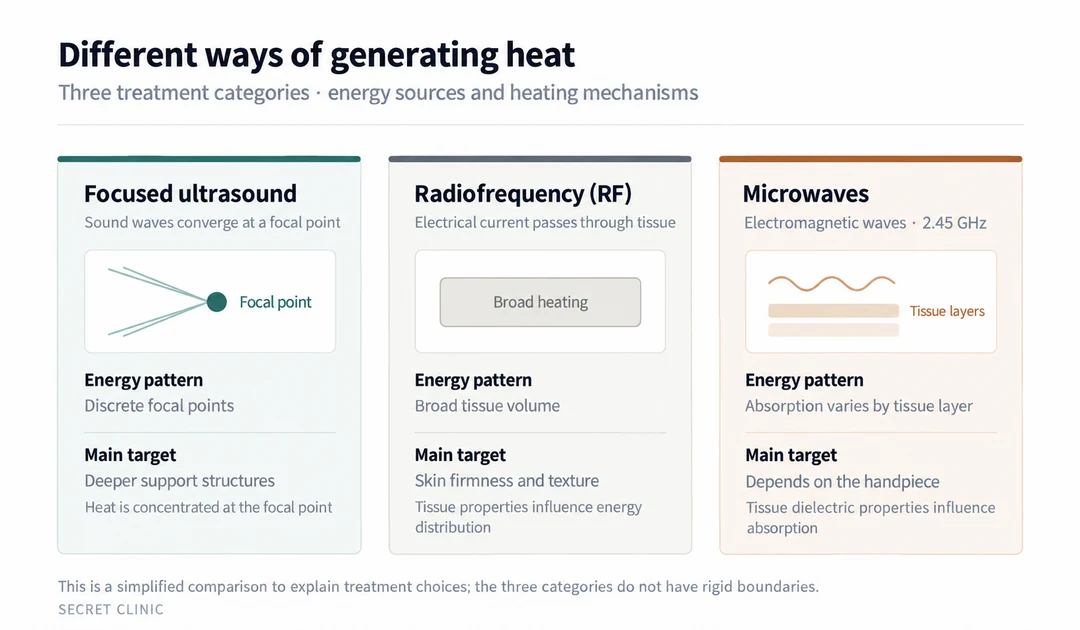
Ultrasound lifting focuses sound waves on a single point.
Heat is generated only at the point where energy is concentrated, while the surrounding area remains relatively unaffected. It is a method that reaches deep layers in point units.
Radiofrequency (RF) lifting sends an electric current. Heat is generated as the tissue resists the current, warming it broadly in surface units. However, because the degree of current flow varies by tissue, the depth of energy penetration depends on the properties of the tissue.
Microwave sends electromagnetic waves. Molecules within the tissue react to these waves to generate heat, and the degree of absorption varies according to the dielectric properties of the tissue. Onda uses the 2.45GHz band, and this difference in absorption is why manufacturers and researchers chose this frequency.
In summary, ultrasound is like a point, RF is like a surface, and microwave is closer to a layer. While these three are not strictly divided this way, this distinction helps in understanding why different equipment is recommended during a consultation.
How deep does it reach?
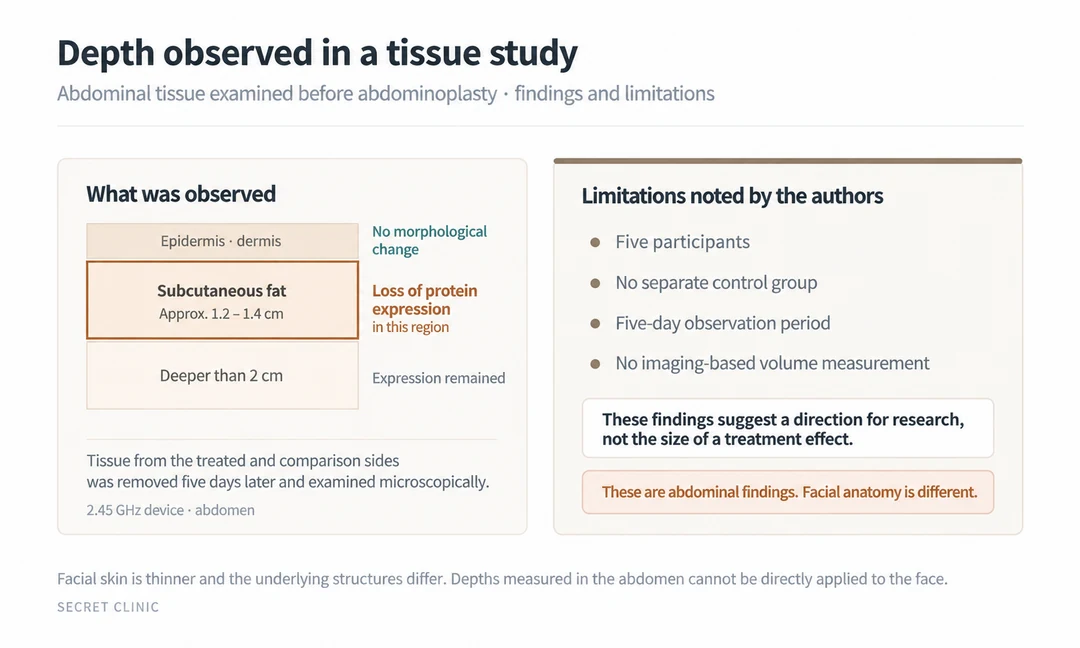
There is a relevant histological study on this. The study involved five subjects scheduled for abdominoplasty; five days before surgery, one side of the abdomen was treated with Onda, and the other side served as a control. The removed tissue was then examined under a microscope.
The results showed that in the treated side, the expression of specific proteins disappeared in fat cells at a depth of 1.2 to 1.4 cm, while they remained intact in layers deeper than 2 cm. The morphology of the epidermis and dermis did not change on either side.
However, the authors themselves noted the limitations of this study. The sample size was only five people, there was no separate control group, the observation period was only five days, and the volume was not measured via imaging. It is data that indicates a direction, not the magnitude of the effect.
And there is one more important point. This study was conducted on the abdomen. The skin on the face is thinner than on the abdomen, and the underlying structures are different. The depth measurements from the abdomen cannot be directly applied to the face.
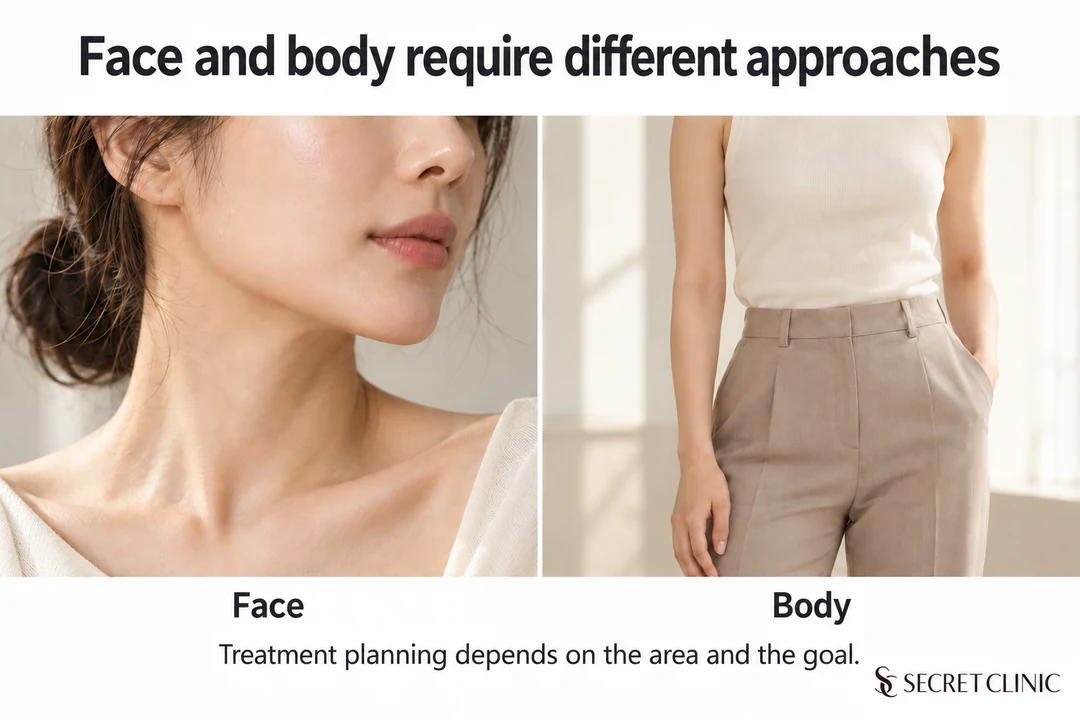
Purposes differ for facial and body applications
This is where this category distinguishes itself from other lifting devices. Onda uses interchangeable handpieces. According to manufacturer data, there are separate handpieces for deep layers, shallow layers, and narrow areas, each targeting different things.
Therefore, saying "I received Onda" under a single equipment name provides very little information. Using it on a narrow area for facial contouring is a different procedure from using it for a broad body treatment. During an Onda consultation in Gangnam, asking which handpiece will be used on which area and how is more practical than just confirming the equipment name.
At Secret Clinic, we do not decide on the equipment first. We look at what has changed in the face now, determine the appropriate approach, and then select the equipment.
The expected scope is determined by regulatory approval
There is something that must be pointed out here.
The intended use stated in materials created by overseas manufacturers may not be the same as the purpose of use for which this equipment is approved domestically. Medical devices undergo separate reviews in each country, and the approval language is determined differently for each. Therefore, advertisements that directly copy phrases from overseas brochures of imported equipment may sometimes exceed the scope of domestic approval.
Particularly in this category, expressions related to fat can easily become problematic. This is also why we do not mention the fat-related effects of Onda in this article. Discussing effects without confirming what is included in the domestic approved purpose of use is the wrong order of business.
The verification method is not difficult. If you search by product name in the Medical Device Electronic Service of the Ministry of Food and Drug Safety, the approved purpose of use will appear exactly as it is. If the explanation you heard during a consultation seems significantly different, you may ask about it on the spot.
When should you consider it?
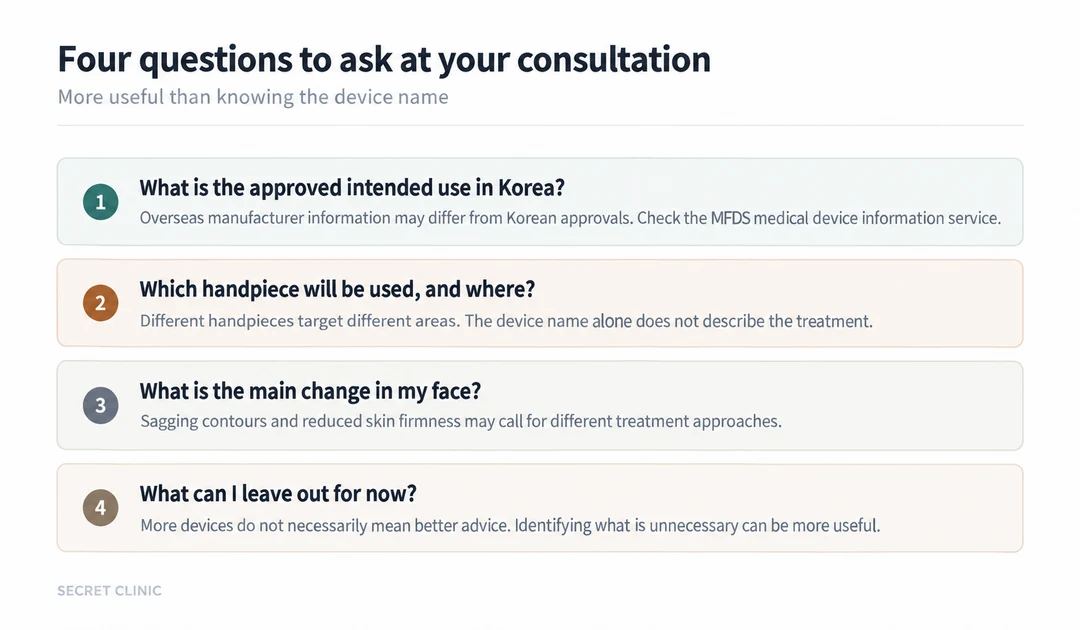
Choosing between the three categories depends on what the primary change in your face is. Many people compare equipment lists first when looking for a dermatology clinic near Sinnonhyeon Station, but the order should be the opposite.
· If the primary issue is a sagging contour, a method that reaches deep layers is necessary.
· If the primary issue is skin surface elasticity and texture, a method that heats in surface units is often appropriate.
· For narrow areas with thickness, such as under the chin, the key is whether there is a handpiece suitable for that area.
· If multiple issues are mixed, it is better to divide the sequence rather than trying to finish everything with one device.
One more thing: having many devices does not necessarily mean a good consultation. A consultation that removes what is not currently needed is more difficult and, ultimately, more useful.
Limitations and Risks to be Aware Of
As this is a heat-based procedure, pain may occur during the treatment. Depending on the area and intensity, it may feel hot or dull, and individual differences are significant.
Temporary redness or swelling may appear after the procedure, which usually subsides without special treatment. In rare cases, skin damage or blisters due to heat may occur, so it is best to speak up immediately if the sensation during the procedure feels unusual.
The changes obtained from this category are also not permanent. Since aging continues after the procedure, it is best not to think of it as a one-time treatment.
Furthermore, if you are pregnant, have metal implants or a pacemaker in the treatment area, or have recently received other treatments in the same area, you must discuss whether to proceed first. Secret Clinic also confirms these items during the initial medical questionnaire.

Onda Microwave is a third category that is neither RF nor ultrasound. Because the principle of heat generation is different, the targets are also different, and its characteristics vary between facial and body use depending on the handpiece.
However, what can be expected from this device is determined by the domestically approved purpose of use, not overseas materials. During a consultation, it is more important to hear why that device is being used for a specific problem on your face than just knowing the name of the equipment.
자주 묻는 질문
Is Onda a radiofrequency (RF) lifting treatment?
No. While both RF and microwave use electromagnetic waves, they use different frequency bands and generate heat in tissue differently. Onda is classified as a microwave system using the 2.45GHz band.
Which is better compared to ultrasound lifting?
It is not a relationship where one can be defined as better. Ultrasound reaches deep layers in point units, while microwave is absorbed in layer units. The choice depends on whether the main problem is a sagging contour or surface elasticity.
I heard that Onda reduces fat. Is that correct?
Since the materials from overseas manufacturers and the domestically approved purpose of use may differ, we will not discuss the effects here. You can directly check the approved purpose of use by searching the product name on the Ministry of Food and Drug Safety's medical device website, or you can ask during your consultation.
Is the same procedure performed on the face and body?
The equipment is the same, but it is better to view them as different procedures. Different handpieces are used, and the targeted areas and goals differ. It is good to confirm which handpiece will be used on which area during the consultation.
How much pain is involved?
As it is a heat-based procedure, you may feel heat or a dull sensation. This varies depending on the area, intensity, and individual differences. If you are sensitive to pain, please let us know when booking so we can discuss the intensity and anesthesia methods together.
Can I return to daily life immediately after the procedure?
Temporary redness or swelling may occur but usually subsides. It is best not to rub the treated area hard on the day of the procedure and to avoid environments with prolonged heat, such as saunas, and excessive drinking for a few days.
How many sessions are required?
Rather than starting with a fixed number of sessions, it is more reasonable to decide on the next step after observing the progress of the first session. It varies by area and condition, and there is no set number of sessions.
Can I receive it along with other lifting procedures?
If the procedures target different layers, they are sometimes planned together. However, whether to proceed on the same day or with an interval depends on the area and intensity. Since evidence for combined intervals is not fully established, it is not universally recommended. If you have recently received a treatment, please inform us of the timing and area.
원리, 상담 대상과 주의사항을 시술 상세페이지에서 함께 확인해 보세요.
시술 상세 보기온라인 상담 신청
현재 고민과 연락 가능한 정보를 남겨주시면 확인 후 상담을 도와드립니다.